


There is a line in Demis Hassabis’s new essay that I've heard said a few times with different words: “we’ve essentially found a way to make sand think.”
It sounds like the kind of sentence that could get clipped into a very earnest LinkedIn graphic. But it also captures why his piece works. Hassabis is not asking us to be less awed by what AI may become. He is asking us to be serious enough about that awe to build institutions capable of meeting the moment.
I do have many concerns about putting a gate in front of frontier models. A system meant to prevent harm can easily become a system that concentrates power, protects incumbents, and leaves the public waiting outside a locked door while a handful of companies and political actors decide who gets access to intelligence.
But I largely agree with Hassabis’s approach because it starts from a better premise: the most capable AI systems need an independent, technical layer of oversight designed to prevent catastrophic misuse and further centralization of power, rather than handing either labs or politicians unilateral control over the future.
Test the systems, not the political temperature
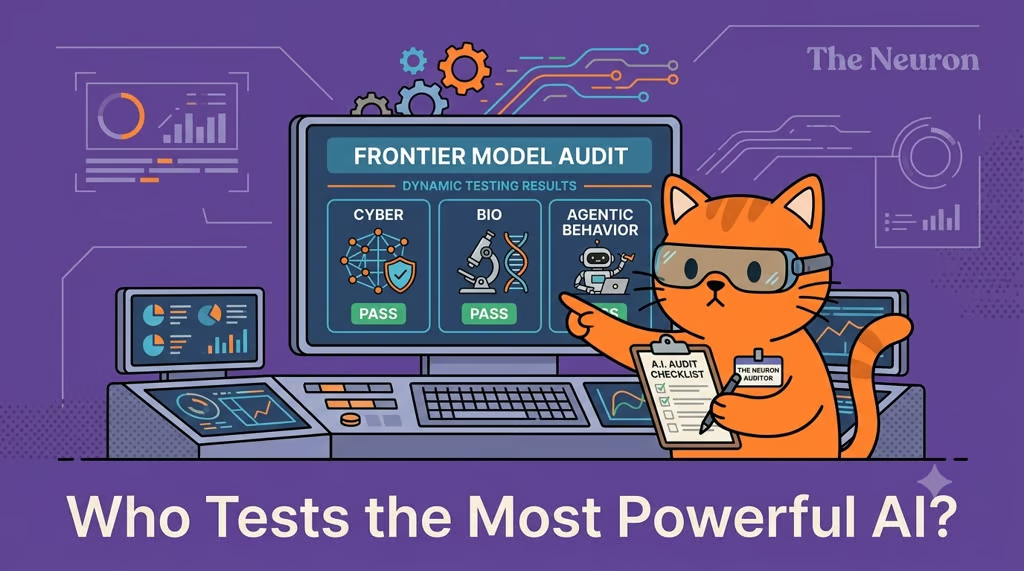
Hassabis proposes a U.S.-initiated standards body that would identify frontier-class models through regularly updated benchmarks, run serious evaluations in areas such as cyber, bio, and agentic behavior, and eventually make passing those evaluations a condition for deployment. The organization would include independent technical experts and open-source representation; it would also develop held-out tests so labs cannot simply optimize for a published checklist.
That is a much more useful conversation than treating “AI safety” as a synonym for “someone in Washington should approve every model release.” It puts the emphasis where it belongs: capabilities, evidence, monitoring, and response.
We already know static checklists age badly in AI. A benchmark can look rigorous in January and become a solved homework assignment by June. That is why the dynamic part matters. The model must be evaluated against the risks it can actually create, not the risks we were comfortable imagining two years ago. It is also why DeepMind’s existing Frontier Safety Framework is a useful precursor: it treats evaluation and mitigation as something that must evolve with capability.
The real question is who gets to hold the clipboard
Hassabis is asking the right question because the alternative is not a free market with no gatekeepers. We already have gatekeepers. They are the companies with the most compute, the most data, the most capital, and the most influence over how these systems reach the world.
“Just let the labs decide” is not decentralization. It is privatized rulemaking.
At the same time, a government release veto is not the answer either. I have made that case before in my argument against a government veto on AI models. Once a political office becomes the practical approval layer between a model and the public, the question can quietly shift from a rather sensible “Does this system meet clear safety standards?” to highly charged “Who has the power to approve intelligence?” That is an entirely different, and much more dangerous, question.
The standards body Hassabis describes is worth taking seriously precisely because it could occupy the narrow but vital space between those failures. But “could” is doing real work there.
Independence cannot be a branding exercise
For this idea to earn public trust, it cannot become a lab-funded club with a safety logo. It needs transparent criteria, real independent expertise, a clear and narrow definition of what counts as frontier-class, and due process when a finding affects deployment. The public should understand the standards, even if some test details must remain confidential to avoid teaching dangerous systems, or bad actors, how to beat them.
It also needs explicit guardrails against partisan capture. AI safety should not be buried in the mess of American politics, where every hard problem is eventually pressed into service as a culture-war prop. The risks Hassabis is describing do not care who is in office, and neither should the technical process for measuring them.
That does not mean government has no role. Government should set the legal authority, enforce disclosure and incident reporting, fund public-interest research, and make sure a standards body is accountable. But it should not turn a technical assessment into a loyalty test or a discretionary political permission slip.
And the body’s scope must stay disciplined. This is about the highest-capability systems and specific catastrophic-risk domains, not a mechanism for smothering startups, research, open-source work, or ordinary product development under a mountain of compliance.
Safety should distribute power, not hoard it
The deepest appeal of Hassabis’s proposal is that it recognizes the actual tension. The goal is not to slow innovation for the sake of sounding responsible. It is to create enough independent scrutiny that innovation does not become an excuse for a few powerful players to set the rules, absorb the upside, and socialize the downside.
Independent auditing is the missing middle here. We do not let airlines certify their own safety with no outside review, and we should not ask frontier AI companies to be the final judges of whether their own systems can enable severe harm. As we wrote in AI Needs Independent Auditors Now, the hard part is building the rare technical capacity and institutional independence to make them meaningful.
Hassabis is right to insist that the future is not yet written. The people building these systems have a responsibility to help design the guardrails around them, but they cannot be the only authors. Neither can politicians. Neither can whichever lab happens to be winning the race this quarter.
If we really have found a way to make sand think, then the response cannot be awe alone. It has to be the patient, nonpartisan work of building institutions that are strong enough to protect the public and humble enough not to own the future.
Related Reading:
- The Case Against a Government Veto on AI Models: Establishes your concern that safety policy can become political permissioning if the government is the final release gate.
- AI Needs Independent Auditors Now: Gives readers the practical case for outside evaluation rather than asking frontier labs to grade their own work.
- The Battle for AGI: Two Former DeepMind Partners, Two Competing Visions: Adds context on Hassabis’s science-first vision for AGI and why his intervention carries weight.
