



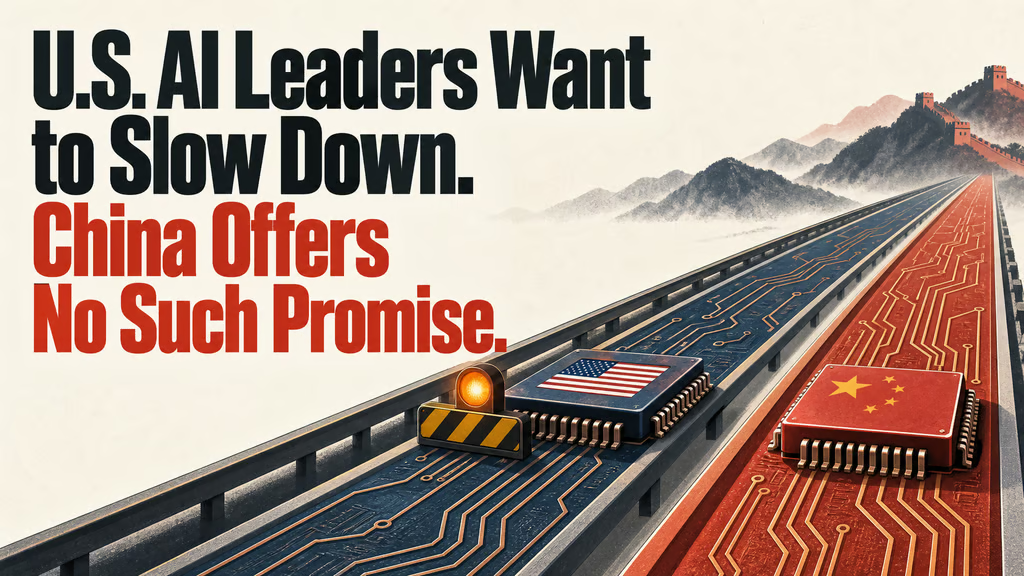
America’s leading AI executives want more time to make their most powerful systems safe. China has rejected the idea that they should slow do, too.
Beijing’s response to the proposed slowdown puts a difficult question at the center of the debate: What happens if American companies ease off and their biggest strategic competitor keeps going?
That possibility was already hanging over the warnings from OpenAI and Anthropic. Now China is pushing back publicly, framing the proposal as an attempt to preserve American technological dominance.
The concern is serious. A slowdown that applies unevenly could change who leads the AI race without doing enough to reduce the risks that prompted it.
On September 14, Chinese Foreign Ministry spokesperson Guo Jiakun criticized “fearmongering, confrontation and vicious competition” in response to a question about Anthropic CEO Dario Amodei’s proposal, according to the Associated Press. His remarks offered no commitment to restrain Chinese AI development.
The state-run Global Times delivered a sharper response. Its commentary on Amodei’s essay called the proposal a “Cold War playbook,” arguing that its restrictions on China would entrench U.S. dominance.
Those statements carry different weight. A Foreign Ministry response is an official government position; a state-media commentary signals political thinking without establishing a binding policy. Together, they give American slowdown advocates little reason to count on matching restraint from Beijing.
But the details matter. China is objecting to a proposal that explicitly ties AI safety to maintaining America’s lead.
In “We Must Pace the Frontier,” Amodei argues for giving safety work time to catch up with advancing capabilities. His plan includes independent evaluators inside frontier labs, coordination among American companies, and efforts toward international agreements. Pacing, he writes, would still allow training and technical progress.
He also calls for restricting China’s access to advanced chips and chipmaking equipment, combating unauthorized model distillation, and preventing model-weight theft. He believes those measures could widen America’s lead over the next three to five years, creating room for a more deliberate development pace.
That forecast carries a lot of weight in the proposal.
For the strategy to work, Washington would need to constrain China’s progress enough that American companies could slow down without surrendering a critical advantage. Beijing would then need a reason to negotiate an agreement whose starting conditions favor the United States.
China’s response suggests that will be a hard sell.
There is a revealing detail in the Global Times criticism: it acknowledges that AI brings security risks, ethical concerns, and the possibility of technology escaping control. It then argues that Amodei’s approach politicizes those shared problems.
So the dispute extends beyond whether AI is dangerous. It concerns who gets to set the rules, who bears the restrictions, and who keeps the lead while everyone adjusts.
That is a much tougher negotiation than agreeing that safer AI would be nice.
China’s broader policy also points toward continued expansion. Its “AI Plus” initiative, announced in August 2025, sets goals for integrating AI across six major areas by 2027. It targets adoption of next-generation intelligent terminals and AI agents above 70% by then, rising above 90% by 2030.
Those are deployment goals, rather than limits or targets for training the most powerful models. Still, they show how firmly AI growth is built into China’s economic plans.
Its Global AI Governance Initiative combines support for risk-based testing and human control with opposition to technological barriers and exclusive international blocs. Beijing has a consistent position available to it: endorse safety cooperation while rejecting restrictions that limit its ability to compete.
We have already seen this tension in the growing use of AI model access as a geopolitical weapon. Chips, cloud capacity, access to models, and the ability to learn from their outputs increasingly sit inside the same strategic argument.
A proposed slowdown makes that argument even more consequential.
If American labs restrain capability development while Chinese labs continue advancing, the gap could narrow. How quickly would depend on compute, research progress, security, and the effectiveness of restrictions. Today’s statements do not establish that China would overtake the United States. They do make clear why a slowdown cannot safely assume reciprocal behavior.
Even a signed agreement would leave the verification problem. Governments would need credible ways to establish what their competitors were doing, detect violations, and respond before cheating delivered an overwhelming advantage.
Meanwhile, the political resistance at home is already substantial. President Donald Trump has pushed back against the CEOs’ calls for new guardrails, arguing that restrictions could allow China to eclipse America.
A nationwide U.S. slowdown is therefore still a contested proposal. Beijing’s response gives its opponents another argument.
None of this makes the underlying safety concerns disappear. A model capable of causing serious harm does not become safe because an American company built it. Competitive pressure can also encourage companies and governments to accept risks they would otherwise reject.
That leaves policymakers facing two dangers at once: losing control of increasingly capable systems, and losing strategic ground to a competitor that accepts fewer constraints.
There is some room for cooperation. China and the United States both endorsed the 2023 Bletchley Declaration, recognizing frontier AI risks and the need to address them together. Shared testing methods, incident reporting, and narrower agreements could offer places to start. But acknowledging a danger is a long way from accepting enforceable limits on development.
For businesses building with AI, this also points toward a less predictable market. Model availability could increasingly depend on government decisions, access restrictions, and safety assessments alongside technical performance. Our earlier argument for testing Chinese models against demonstrable risks becomes more relevant as geopolitical pressure grows.
China has not categorically ruled out every safety agreement. It has given no reason to assume that it will accept the slowdown now being proposed.
Anyone advocating American restraint needs a convincing answer to what happens if Beijing keeps moving. Anyone advocating full-speed development needs an equally convincing answer to the risks the builders themselves are raising.
The uncomfortable part is that both questions need answers at the same time.
Related reading
- AI Model Access Is Becoming a Geopolitical Weapon — How access to models, cloud infrastructure, and AI capabilities became part of the U.S.-China competition.
- The China AI Theft Claims Are Real. So Is the Case for Open Models — Background on the distillation debate behind proposals to protect America’s AI lead.
- Don’t Ban Chinese Open AI Models. Test Them. — Why practical security assessments matter as governments scrutinize Chinese AI.
