



Welcome, humans.
We hope you like sriracha in your Earl Gray because we’ve got some spicy tea for y’all today:
Greg Brockman took the stand at the Musk v. Altman trial yesterday and confirmed his personal OpenAI stake is now worth nearly ~$30 billion. Not too shabby… But the star witness was not Brockman himself, but his journal…
That’s right: Musk's lawyer read Brockman's personal journal aloud to the jury, including a 2017 entry asking himself "Financially, what will take me to $1B?" and another where Brockman described OpenAI's public commitment to its nonprofit mission as "a lie."
Brockman's defense from the stand: these are hundreds of pages of stream-of-consciousness self-doubt, not some master plan. And just think, this was 2017, so before ChatGPT was good enough to actually conspire brainstorm with… wonder if these days Brockman does his scheming stream of consciousness self doubt journaling with GPT.
Meanwhile, John Gruber of Daring Fireball did some investigative journalism and discovered that Y Combinator quietly owns roughly 0.6% of OpenAI (worth ~$5B at the current $852B valuation), which could mean YC co-founders Paul Graham and partner Jessica Livingston have personal billions riding on Sam Altman keeping his job.
Gruber says Graham spent the last few weeks publicly defending Altman in that new “can we trust Sam Altman?” New Yorker piece and on X; and per Gruber, he's conspicuously stopped short of ever actually calling Altman trustworthy or a man of integrity.
If only we had an impartial, totally unbiased, perhaps literally mechanical witness with absolutely nothing to gain to attest to Sam’s character once and for all… Wait, we’ve got it!
Picture Law and Order’s Jack McCoy: “Your Honor, the prosecution would like to call ChatGPT to the stand.” Who better to read someone’s chat logs into the record than the chatbot itself? Better hope you fixed those hallucinations fam!
Here’s what happened in AI today:
😺 Mayo + Harvard: AI just beat doctors at their hardest jobs.
📰 The White House quietly considers pre-release AI model vetting.
📰 Anthropic and OpenAI both signed PE joint ventures.
🍪 Cursor Team Kit ships the workflows Cursor devs use internally.
🎓 Use o1 / Claude as a "second opinion" before big decisions.
Hey: Want to reach 700,000+ AI-hungry readers? Advertise with us!
P.S: Love robots? We’re starting a new robotics newsletter! Sign up early here.

Two peer-reviewed studies dropped this week showing AI now beats specialist physicians at the two hardest parts of medicine: catching invisible disease early, and triaging patients in the first uncertain minutes.
First up: Mayo Clinic's REDMOD model spotted pancreatic cancer up to three years before diagnosis (study).
The team analyzed nearly 2,000 routine CT scans originally read as normal, including scans from patients later diagnosed with the disease.
REDMOD flagged 73% of those prediagnostic cancers, vs. 39% caught by specialist radiologists looking at the same images.
Median lead time: 16 months.
For scans taken more than two years pre-diagnosis, the AI was three times more sensitive than human experts.
This is a big deal. Pancreatic cancer kills most patients precisely because we catch it too late (13% five-year survival, 80% diagnosed at advanced stage). REDMOD changes that math.
Next up: Harvard's Science paper on OpenAI's o1, and admittedly older model, is fascinating. Researchers at Harvard, Beth Israel Deaconess, and Stanford ran six experiments pitting o1 against attending physicians (study).
The headline test: 76 real Beth Israel ER cases where the model got 67% of triage diagnoses exactly or near-exactly right.
The two attendings scored 55% and 50%.
Blinded reviewers couldn't tell which diagnoses came from the humans.
The gap was largest in the first minutes of triage, when information is sparse and stakes are highest.
Now, it’s worth noting: Both teams stopped short of recommending clinical deployment and called for prospective trials.
Why this matters: These studies test something harder than memorized medical knowledge (Vox notes that "knowing the diagnosis isn't treating the patient"). They measure reasoning under uncertainty with incomplete information, which is, y’know, the actual hard part of medicine. AI cleared that bar twice in one week, on different problems. And this is far from frontier AI we’re talking about here, at least as far as the triaging study goes.
Our take: AI-assisted triage in under-resourced ERs just became a near-term policy question. "Second opinion" tools may become standard before major diagnoses (the way spell-check became standard before sending an email… at least for SOME of us).
Now, Medical AI liability frameworks are nowhere near ready; but that's tomorrow's problem. Mayo's senior author Dr. Ajit Goenka put it cleanly: "In a disease where we have been just wandering in darkness for decades, this is a milestone that shows us the finish line, but we still have to get to the finish line." I think we all want a little bit more news like this, right?

FROM OUR PARTNERS

More than 50 companies are backing Arm’s move into silicon — spanning cloud, chip design and software.
From AWS, Google and Microsoft to NVIDIA, Samsung, SK hynix and TSMC, the ecosystem signals a broader shift in how AI infrastructure is being built.
Rather than isolated components, the stack is becoming more tightly integrated — from architecture through to deployment.

Today's Harvard study showed o1 (an older generation reasoning model from OpenAI) beating ER attendings most decisively in the first minutes of triage, when information is sparse and pressure is high.
Most workplace decisions look exactly like that: contract negotiations, hiring calls, architectural choices, budget approvals. The skill is feeding a reasoning model your conclusion plus your reasoning, then asking it to find what you missed.
Drop this into GPT 5.5 with reasoning on, Claude Opus 4.7, or Gemini 3.1 Pro
I've concluded [DECISION] based on the following reasoning: [YOUR REASONING].
Before I commit, I want a structured second opinion. Please:
1. Identify the strongest argument against my conclusion.
2. Generate three alternative hypotheses I may have missed.
3. List the specific evidence or scenarios that would shift your assessment in either direction.
4. Flag any assumptions in my reasoning that look load-bearing but aren't actually supported.
Be direct. I'm looking for the version of this analysis I'd get from a sharp colleague who isn't trying to spare my feelings.
The trick is forcing yourself to write out your reasoning before pasting. Half the value is in that step alone; the model just stress-tests the rest.
Total AI beginner? Start here (goes with this video).
Have a specific skill you want to learn? Request it here.
Cursor Team Kit ships the internal CI watcher, code-review harness, deslop cleaner, and shipping workflows Cursor devs use themselves; runs locally, no third-party services —free to try.
Unity AI entered open beta with a project-aware in-editor agent (plus AI Gateway and MCP Server) trained on 20+ years of Unity practices that automates tasks, generates assets from designs, and drives Editor actions —free trial, then $10/month for Personal.
Vercel deepsec is an open-source CLI (command line) security harness that runs pluggable coding agents in parallel sandboxes on your own infra (with your keys) to surface and validate vulnerabilities in large codebases with low false positives, free to try.
Pocket TTS by Kyutai Labs runs open-source 100M-parameter text-to-speech models in six languages on your CPU in real time, no GPU required —free to try.
Saperly is the first phone carrier built for AI agents; provision a real number in seconds via any MCP-compatible agent for unified calling, SMS, and stable caller ID with audit trails —first number free for 30 days, then $2.50/month + usage.
Adaptive Passport lets your agent sign up for new accounts and acquire API keys, service credentials, and other requirements without you in the loop, covering 61+ services including FRED so the agent can build a continuously syncing economic-data model on its own, paid only rn.
Codex Pets gives you an animated pixel companion that floats on your screen and pings you when OpenAI's Codex coding agent finishes a task or needs input, with a community gallery where you can install custom pets like Clippy or Goku in a single command (Mashable).


The Trump White House is quietly considering pre-release AI vetting through a potential executive order forming a working group with tech executives, a sharp reversal of its deregulation stance prompted by cybersecurity concerns over Anthropic's Mythos model. (good article on why)
Anthropic and OpenAI both signed parallel PE joint ventures on the same day; Anthropic CCO Paul Smith also spun out a $1.5B mid-market vehicle backed by Blackstone, while OpenAI finalized a $10B partnership with TPG, Brookfield, Advent, and Bain.
Bret Taylor's Sierra raised $950M Series E at a $15.8B valuation, pushing total capital above $1B for its AI customer-service agents.
Long Lake agreed to acquire Amex GBT for $6.3B in an all-cash deal explicitly betting that AI will reshape corporate travel.
Arizona State University deployed ASU Atomic, an AI tool that auto-chops faculty lectures into learning modules without telling or asking the professors, who called the outputs inaccurate "AI slop."
The Academy of Motion Picture Arts and Sciences ruled that AI-generated performances and screenplays are no longer eligible for Oscars, requiring acting roles to be "demonstrably performed by humans with their consent" — effectively shutting out synthetic stars like AI "actress" Tilly Norwood from awards contention.

FROM OUR PARTNERS
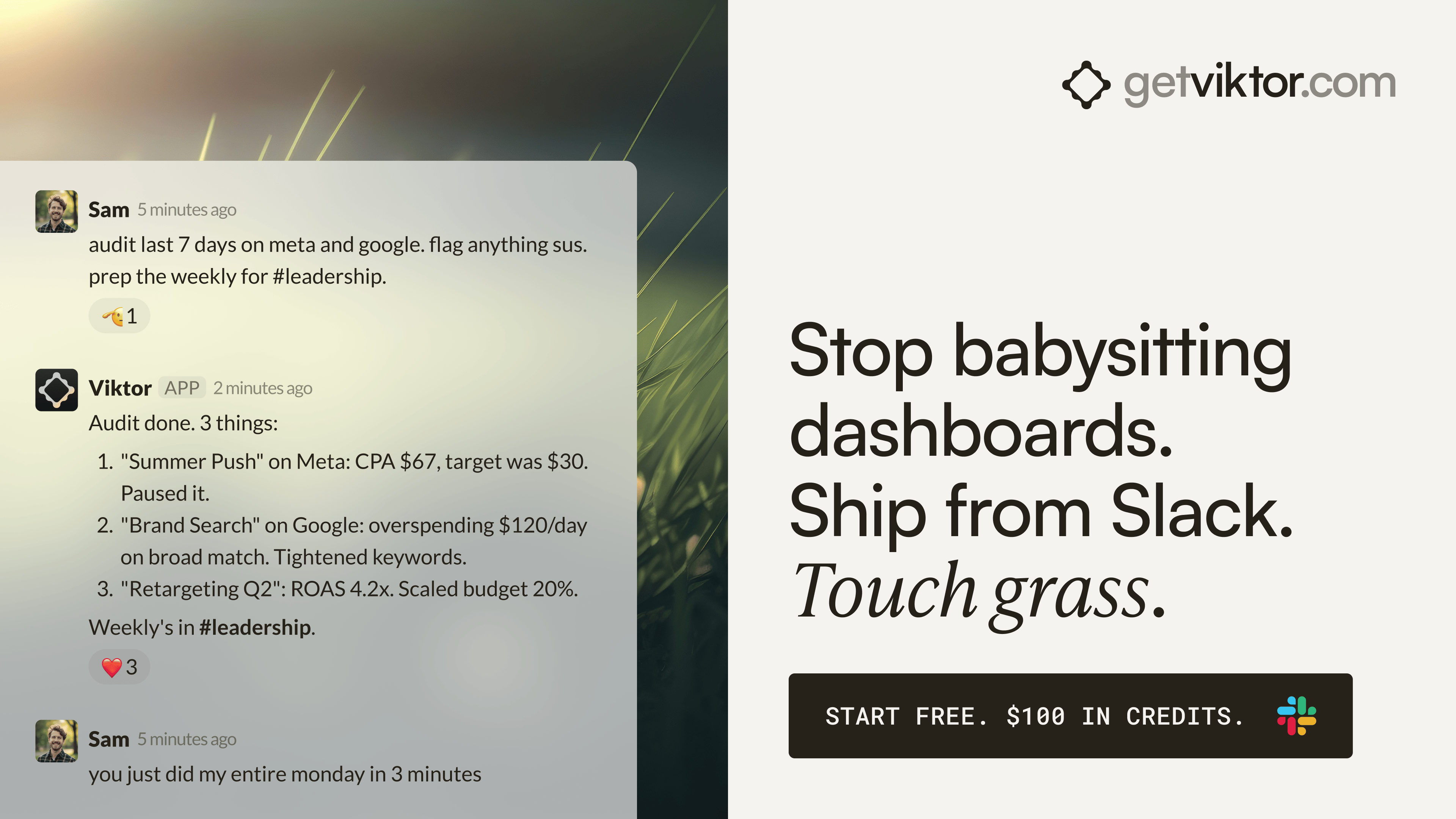
Each page mapped to a specific ad group. All deployed within hours. Viktor wrote the code and shipped every one from a Slack message.
That same team has Viktor monitoring ad accounts across the portfolio and posting performance briefs before the day starts. One colleague. Always on. Across every account.
5,700+ teams. 3,000+ integrations.

Three from the weekend that earned their virality:
Justin Skycak (13,645 likes): "Never underestimate how much time and effort you can waste by trying to automate a process you do not understand manually." Tape this above your IDE.
Sam Altman (13,054 likes): "i keep thinking i want the models to be cheaper/faster more than i want them to be smarter but it seems that just being smarter is still the most important thing." The whole AI industry's quarterly roadmap, right there.
Mark Cuban (3,205 likes) on enterprise AI's biggest blocker: same question, different answers, every time. He frames the non-determinism as evidence against doomers since it proves the models clearly don't understand consequences.


 | That’s all for now.
|
Grant Harvey is the Lead Writer of The Neuron, where he continues to lead the publication's daily coverage of AI news, tools, and trends.

Don't fall behind on AI. Get the AI trends & tools you need to know. Join 700,000+ professionals from top companies like Microsoft, Apple, Salesforce and more.
Property of TechnologyAdvice. © 2026 TechnologyAdvice. All Rights Reserved
Advertiser Disclosure: Some of the products that appear on this site are from companies from which TechnologyAdvice receives compensation. This compensation may impact how and where products appear on this site including, for example, the order in which they appear. TechnologyAdvice does not include all companies or all types of products available in the marketplace.
