
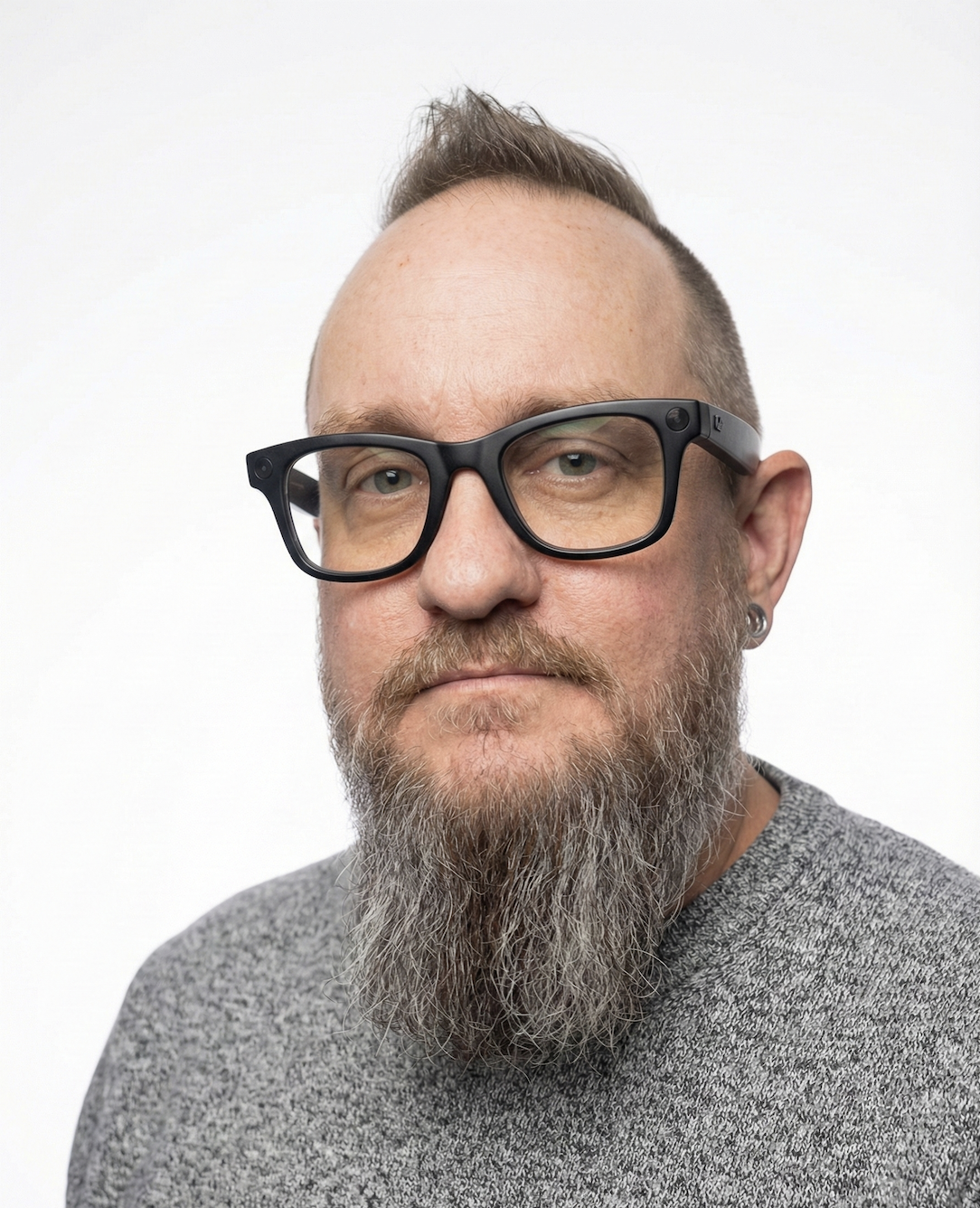

Click the image to watch on YouTube!
Welcome, humans.
AI keeps getting bigger.
Bigger models. Bigger data centers. Bigger energy bills. Bigger debates about whether today’s chips can keep up.
But Jeff Shainline thinks the next big AI breakthrough may not be a bigger model at all.
It may be a completely different kind of computer.
Jeff is the co-founder and CEO of Great Sky, a company building brain-inspired AI hardware using superconductors, photons, analog computation, and an architecture called Superconducting Optoelectronic Networks, or SOENs.
That sounds wildly technical.
But the basic idea is simple: today’s computers constantly shuttle data back and forth between memory and processors. Great Sky wants to get rid of that bottleneck by building hardware where memory and processing are intertwined, more like the brain.
And instead of moving information around the way a normal chip does, Great Sky’s system uses light.
In our latest podcast episode, we talked to Jeff all about what he’s built, how his computing architecture works, why AI’s GPU-heavy roadmap may eventually run into a memory-and-energy bottleneck (arguably happening now), and what to watch next: a Brookhaven fusion deployment later this year, specialist systems for real workloads in two to three years, and larger data-center deployments after that.
Click the Image to watch on YouTube
(01:18) What “brain-like computing” actually means.
(03:15) The old computer architecture problem.
(06:53) Why AI may need analog values and more connections.
(10:58) Not quantum computing, but quantum-adjacent.
(15:22) Why computing at four Kelvin may not be the hard part.
(17:18) How SOENs split work between electrons and photons.
(21:33) Can Great Sky run language models?
(25:28) Why transformers may be powerful overkill.
(30:33) Computing video at 60 million frames per second?!
(34:37) Fusion reactors as an early test case.
(36:05) Turning money into chips.
(39:23) First markets: science, cloud, and hyperscalers.
(43:13) Use-case: watching every frame for content moderation.
(46:11) What “delivering chips” means this year.
(46:50) Great Sky’s 100M-parameter roadmap.
(48:31) What foundries would need to change (not much!).
(54:35) Getting rid of the memory bottleneck (big deal!).
(58:01) Scaling with wafers, optics, and superconductors.
(01:00:31) Where to follow Great Sky.
Bottom line: The future of AI infrastructure may not just be more GPUs in bigger data centers. It may be new hardware built around different assumptions entirely: analog values, high connectivity, memory next to compute, and communication at the speed of light.
Watch and/or Listen now: YouTube | Spotify | Apple Podcasts
P.S. Brain-like computing is a fascinating avenue of research. This is a great one to watch if you love knowing what’s next in tech!
This Great Sky conversation is the hardware version of the Transformer vs. Post-Transformer debate. If you don’t know, the transformer is the architecture that most modern language models (the AI you are used to interacting with) are built on today.
In that debate, Transformer co-author Llion Jones warned that “the success of the Transformer is stopping us from finding the next thing,” because the field is “stuck in a local minima.” Later, when the audience asked how anyone can move past Transformers while today’s hardware still rewards them, Jones named the trap directly: “the hardware lottery.”
His point was simple: architectures win partly because they fit the machines we already have. Or as he put it, the real Transformer breakthrough was hardware (NVIDIA’s “GPU”): processing tokens “literally thousands of times faster” and scaling better.
That is what makes Great Sky so interesting. Jeff’s argument is basically: change the machine, and you change which model ideas can win.
He says recurrent and brain-inspired systems have often looked worse because they “don’t map as well to the chips” we’ve had for the last 20+ years, while Transformers won partly because they map well to GPUs. Great Sky’s bet is that superconducting circuits and optical communication could give those older, weirder, more brain-like architectures a proper home. Plus, it could lead to new optimizations for how we build and run language models, energy models, state space models, and who knows what else.
That also ties into our recent verification ladder framing on AI progress. AI progress moves fastest where the AI system can test, score, and improve cheaply. Hardware changes that feedback loop. Make a workload cheaper to run, faster to test, or easier to scale, and suddenly a once-impractical architecture can start climbing the scoreboard.
So the Great Sky question is more than “can this new chip beat a GPU?” It is whether a new compute substrate can make a different kind of intelligence economically testable, and therefore viable (or even, the most viable) in the arena of real-world applications.
Keep scrolling for info on our new livestream and four more videos we think you’ll love!


Click the image above, then on YouTube, click “Notify Me” to get notified right when we go live!
Join us LIVE tomorrow for A Total Beginner’s Guide to AI Agents & Automation. We’ll break down what AI agents actually are, how automation workflows work, and how to start using tools like ChatGPT, Claude, Make, and ClickUp (and possibly others!) without getting buried in jargon.
Bring your questions (seriously, anything) and leave with a clearer sense of how to get started using AI agents as soon (and as easily) as humanly possible. Oh, and check this out: no coding required.

Four recent interviews you’ll definitely want to check out (pick whatever looks interesting to you and dive in!):

TL;DW: Rebecca Paul, Head of Medicinal Drug Design at Isomorphic Labs, and Michael Schaarschmidt, Foundational AI Research Lead, explain why drug discovery is still brutally slow, expensive, and failure-prone and how foundation models could help scientists design better drug candidates faster. Their big point: “AI-designed drugs” are not one magic model. It takes many models working together across biology, chemistry, structure prediction, molecule generation, and human judgment.
Why you should watch: If you’ve ever wondered what comes after AlphaFold, this one gets into it. There’s a great section on how something that once could take an entire PhD to validate experimentally can now sometimes be predicted in seconds or minutes, and a wild bit about the dream of getting from a protein target to a drug candidate in one design cycle. Also: “undruggable” proteins may not stay undruggable forever.
YouTube: Watch Here
Spotify: Listen Here
Apple Podcasts: Listen Here

TL;DW: Rebecca Paul, Head of Medicinal Drug Design at Isomorphic Labs, and Michael Schaarschmidt, Foundational AI Research Lead, explain why drug discovery is still brutally slow, expensive, and failure-prone and how foundation models could help scientists design better drug candidates faster. Their big point: “AI-designed drugs” are not one magic model. It takes many models working together across biology, chemistry, structure prediction, molecule generation, and human judgment.
Why you should watch: If you’ve ever wondered what comes after AlphaFold, this one gets into it. There’s a great section on how something that once could take an entire PhD to validate experimentally can now sometimes be predicted in seconds or minutes, and a wild bit about the dream of getting from a protein target to a drug candidate in one design cycle. Also: “undruggable” proteins may not stay undruggable forever.
YouTube: Watch Here
Spotify: Listen Here
Apple Podcasts: Listen Here

TL;DW: Peter Wilczynski, CPO at Vantor (formerly Maxar), built a 3D model of the entire Earth at 50cm resolution and made it machine-readable. He argues spatial intelligence is the gap nobody's talking about in AI, and probably the missing piece before agents can actually operate in the physical world.
Why you should watch: If you've ever wondered why AI can write code and solve math olympiad problems but still can't reliably tell a drone where to go, this one answers it. Also, there's a wild bit about how the physical world becomes the new navigation layer for AI agents.
YouTube: Watch Here
Spotify: Listen Here
Apple Podcasts: Listen Here

TL;DW: Corey sits down with Kendall Rankin, who left LinkedIn in 2024 to join Producer AI when it was a startup (advised by The Chainsmokers, no less). Google acquired the team in February 2026, and Kendall is now on the Flow Music team inside Google Labs. On the episode, they generate a garage rock song from a single sentence, build a custom synth in the "Spaces" feature, and walk through SynthID watermarking and one-shot music videos.
Why you should watch: Most AI music demos hand you a polished finished song and skip the part where things go sideways. This episode is the part where things go sideways. First pass fumbles, Corey asks for "more fuzz," second pass actually lands. That iteration loop is the whole story for anyone trying to figure out if these tools are actually usable.
YouTube: Watch Here
Spotify: Listen Here
Apple Podcasts: Listen Here
Last thing: And if you haven’t subscribed yet, please do! Click the image below to go to our channel and hit “subscribe” to get notified right when new videos go live.

We have a goal to hit 50K subscribers by the end of the year (if not 100K), and we’re about to cross 20K! If you like learning about AI, and already watch some of our videos, do us a favor and click here to subscribe today.
Stay curious,
The Neuron Team
What'd you think of this podcast episode?Pick an answer below, then tell us why with the "additional feedback" option. |
P.P.S: Love the newsletter, but don’t want to receive these podcast announcement emails? Don’t unsubscribe — adjust your preferences to opt out of them here instead.
Corey Noles is the Host of The Neuron: AI Explained podcast and Managing Editor of AI and Experimental Content at TechnologyAdvice, where he leads the charge in testing and refining emerging content strategies across the company's portfolio.

Don't fall behind on AI. Get the AI trends & tools you need to know. Join 700,000+ professionals from top companies like Microsoft, Apple, Salesforce and more.
Property of TechnologyAdvice. © 2026 TechnologyAdvice. All Rights Reserved
Advertiser Disclosure: Some of the products that appear on this site are from companies from which TechnologyAdvice receives compensation. This compensation may impact how and where products appear on this site including, for example, the order in which they appear. TechnologyAdvice does not include all companies or all types of products available in the marketplace.
